

Endorfy Stratus 140 PWM: a case fan that has to earn its retail price
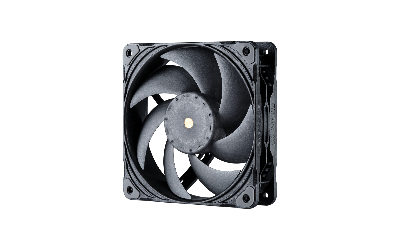
The Stratus 140 PWM is Endorfy’s 140mm, 25mm-thick PWM fan, listed at 200–1200 RPM. That is a modest ceiling for a 140mm design, and it tells you most of what the fan is for before you read another word. This is not the flagship. Endorfy’s main retail fan line is Fluctus, which runs to 1800 RPM and carries the company’s patented sawtooth leading-edge blade, the psychacoustic tuning developed with Synergy Cooling, the FDB bearing rated for 100,000 hours, the six-year warranty and the Cybenetics Airflow Titanium certification on the 120mm model. The Stratus sits below that. Its documented history is as an OEM fan: the Signum 400 case ships with four Stratus 120 PWM ARGB units pre-installed. The 140mm non-ARGB PWM version is the quiet, plain-black member of that family, sold on its own. Buyers should read it as a case-ventilation fan with a low speed ceiling, not as a radiator fan and not as a Fluctus substitute.
Specs at a glance
| Spec | Value |
|---|---|
| Model | Stratus 140 PWM |
| Brand | Endorfy |
| Size | 140 mm |
| Thickness | 25 mm |
| Speed | 200–1200 RPM |
| Connector | 4-pin PWM |
| Lighting | None |
| Colour | Black |
Endorfy does not publish static pressure, airflow in CFM or m³/h, bearing type, MTBF, or warranty length for this specific model. Those figures exist for Fluctus and should not be assumed here. The 200–1200 RPM range is the only performance number the maker states, and it should be treated as the whole performance claim until a full data sheet appears.
What the numbers mean
Fan selection comes down to the balance between airflow and static pressure. Airflow is volume moved against little resistance; static pressure is the force available to push air through obstruction. A 140mm fan at 1200 RPM sits on the airflow side of that trade by geometry alone: the large swept area moves a lot of air at low rotational speed, which keeps tip speed and therefore noise down. The 200 RPM floor is the more interesting figure. At that speed the Stratus is barely turning, and in a case with a filtered front intake and a mesh top, it will move very little. That is the point: the low floor exists so the fan can idle quietly under light load, and the 1200 RPM ceiling exists so it never becomes the loudest component when the curve ramps up. What the Stratus cannot do is generate meaningful pressure. Without a published pressure rating, the safe engineering assumption is that a 25mm fan capped at 1200 RPM is not built to force air through a dense radiator fin stack or a thick dust filter. Endorfy’s design language for this tier is a conventional blade profile; the sawtooth leading edge and psychacoustic optimisation are Fluctus features, not Stratus ones, and buyers should not expect the patented geometry to trickle down.
Where it fits
The natural home is case intake and exhaust in an ATX or micro-ATX build where the fan is not fighting a radiator. A 140mm rear exhaust running at 800–1000 RPM under load is close to inaudible and clears hot air effectively. Two of them as front intake behind a mesh panel, not a foam filter, will feed a mid-range GPU and CPU cooler adequately. In a dust-filtered front, the low ceiling becomes a liability: expect to run near 1200 RPM to maintain positive pressure, and accept the noise that comes with it.
For a 240mm or 360mm AIO, the Stratus is the wrong choice. Radiator fins are a high-restriction path, and a 1200 RPM ceiling with no published pressure figure gives no reason to expect it to perform there. Use a pressure-oriented fan instead. In a small ITX chassis, the 140mm size may not fit at all; check clearances against the 140mm fan database before ordering. In a budget office or home-theatre PC, the 200 RPM floor and the 25mm frame are a good match: the fan can sit at minimum speed and stay out of the way.
What it is not
It is not a Fluctus. If you want Endorfy’s six-year warranty, FDB bearing and 100,000-hour MTBF, those are documented on the Fluctus line, not on this model, and the Stratus should not be bought on the assumption that the warranty carries over. It is not a high-static-pressure fan: no published pressure rating, a 1200 RPM ceiling, and a blade design that does not claim pressure optimisation. It is not an ARGB fan in this version; the ARGB variant exists in the Stratus 120 line and in the 140mm Fluctus range, but this SKU is the plain PWM model. And it is not a radiator fan. Anyone building a custom loop or a high-wattage AIO should look elsewhere.
How it compares
Within Endorfy’s own catalogue, the Fluctus 140 PWM is the obvious step up: same 140mm footprint, but a 250–1800 RPM range, FDB bearing, 100,000-hour rating, six-year warranty, and the patented blade geometry. The Stratus 140 PWM is the value tier, and it should be priced accordingly. Against the wider market, the Stratus competes on the low-speed end of the 140mm segment, where the 200 RPM floor is the differentiator. Its weakness is the missing data: without published pressure, airflow or bearing specs, it cannot be compared on paper against fans that publish full curves. That is a real limitation for anyone doing thermal planning, and it is why the Endorfy Stratus 140 PWM full specs page should be read as a short document. For the rest of the range, see all Endorfy fans, and for cross-brand comparison, the full fan database.
Verdict
Buy the Stratus 140 PWM if you need a quiet 140mm case fan for a mesh-fronted ATX build and you value the 200 RPM floor more than peak airflow. Do not buy it for a radiator, a dense dust filter, or a small ITX case where the 140mm frame will not fit. If you want Endorfy’s engineering story, the Fluctus 140 PWM is the model that carries it; the Stratus is the budget case fan, and it should be bought as one.


Comment List (0):
Load More Comments Loading...